Author: Muzammil Hassan
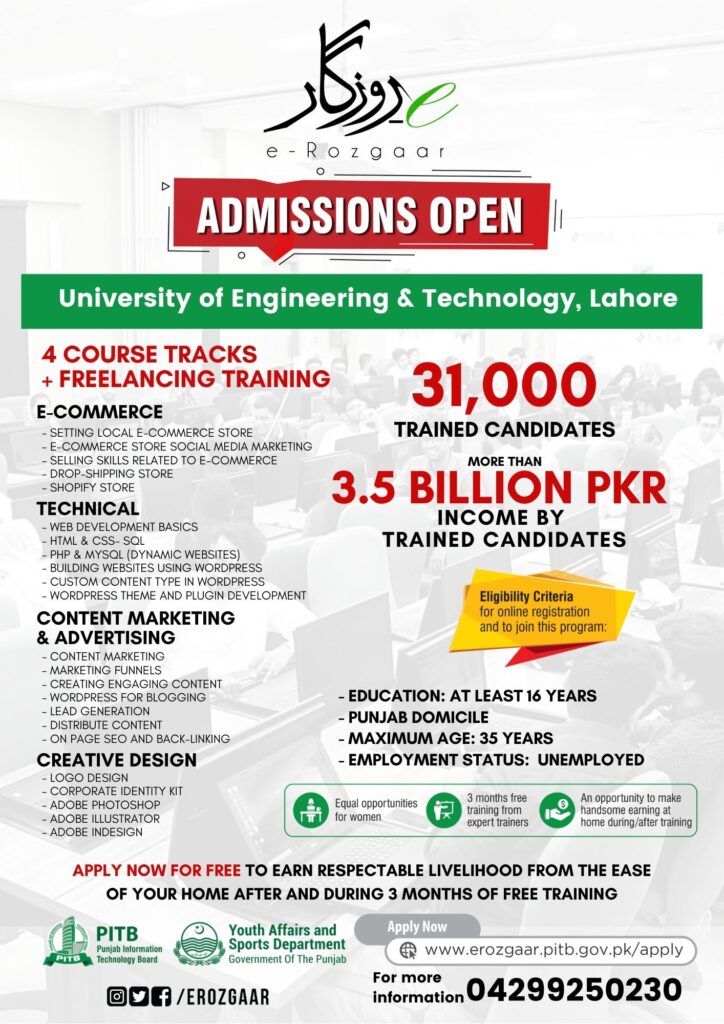
ADMISSIONS FOR e-Rozgaar ARE OPEN AT UET, LAHORE!
Courses we are offering:
1- E-Commerce
2- Technical
3- Creative Design
4- Content Marketing and Advertising
Eligibility Criteria:
– 16 years of education
– Punjab Domicile
– Maximum age: 35 years
– Employment Status: Unemployed
Apply Now: https://www.erozgaar.pitb.gov.pk/apply
Freelancing Course is taught along with all the above-mentioned courses so the trainees can learn to monetize their skills.
Steps to apply:
– Click on the link given
https://www.erozgaar.pitb.gov.pk/apply
– Fill the form with your information and select your training mode PHYSICAL or ONLINE training. (Provide actual information because you’ll be asked to get this information verified later on)
– After signup, you’ll receive an email and SMS containing your login details
– Login through the candidate login link available in the email using the login ID and password details present in the same email
– After successful login, you’ll be asked to attempt an MCQs based online test consisting of 30 questions in 30 minutes
(Make sure you have stable internet and power backup because the failure of power/internet may cause blockage to test access)
– After signup, You will have 72 hours to give your online test. Otherwise, your application will be considered null and void.
(𝗬𝗢𝗨 𝗖𝗔𝗡’𝗧 𝗖𝗛𝗔𝗡𝗚𝗘 𝗬𝗢𝗨𝗥 𝗖𝗢𝗨𝗥𝗦𝗘, 𝗠𝗢𝗗𝗘 𝗢𝗙 𝗧𝗥𝗔𝗜𝗡𝗜𝗡𝗚 𝗔𝗡𝗗 𝗬𝗢𝗨𝗥 𝗖𝗘𝗡𝗧𝗘𝗥 𝗢𝗡𝗖𝗘 𝗬𝗢𝗨 𝗛𝗔𝗩𝗘 𝗦𝗘𝗟𝗘𝗖𝗧𝗘𝗗 𝗜𝗧 𝗪𝗛𝗜𝗟𝗘 𝗔𝗣𝗣𝗟𝗬𝗜𝗡𝗚)
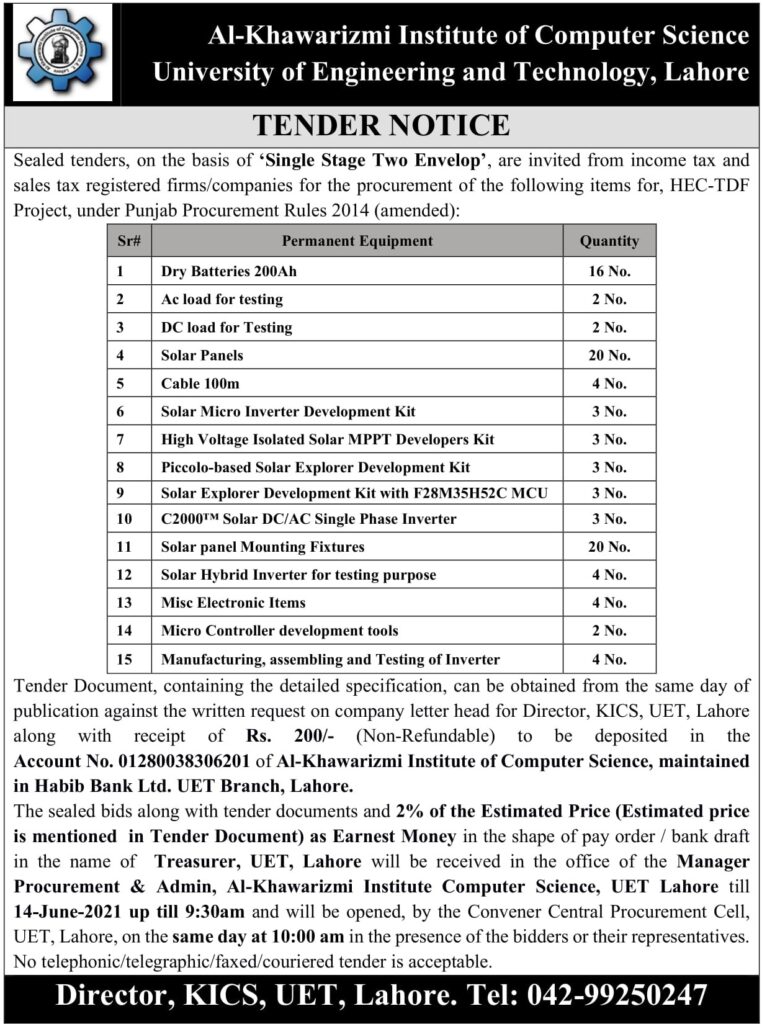
Equipment for Tendering
Re-Tender Notice NCAI | Phase II

Re-Tender Notice – High-Tier Data Server

RE-TENDER NOTICE PROCURMENT OF EQUIPMENT

TENDER NOTICE – PROCUREMENT OF EQUIPMENT

IEEE National Workshop on Big Data & Cloud Computing 2020
Al-Khwarizmi institute of computer science (KICS) UET Lahore in collaboration with IEEE COMSOC Lahore Chapter is organizing this year “IEEE National Workshop on Big Data & Cloud Computing (Virtual)”.

Event Date: 23 September 2020 | Time: 10:00 AM Pakistan Standard Time (PST) GMT+5
| Time *Pakistan Standard Time | Event Schedule |
| 10:15-10:20 PST | Opening |
| 10:20-10:25AM PST | Welcome note by Dr. Waqar Mahmood,Director Al-Khawarzimi Institute of Computer Science |
| 10:25-10:30AM PST | Message by Mr. Kashif Bashir,Chair COMSOC Lahore Chapter |
| 10:30AM-11:45AM PSTDistinguished Lecturer of IEEE Communication Society | Big Data Privacy from Network and Artificial Intelligence PerspectiveProfessor Shui yu, Sydney University Australia |
| 11:45AM- 12:30PM PST | Challenges of Building Urdu Language Search Engine using Open Source toolsDr. Amir Mehmood, KICS UET Lahore |
Speakers Profile:
Professor Shui yu will join us from Sydney Australia; he is a Professor of the School of Computer Science, University of Technology Sydney, Australia. Dr. Yu’s research interest includes Security and Privacy, Networking, Big Data, and Mathematical Modelling. He has published two monographs and edited two books, more than 300 technical papers, including top journals and top conferences, such as IEEE TPDS, TC, TIFS, TMC, TKDE, TETC, ToN, and INFOCOM. Dr. Yu initiated the research field of networking for big data in 2013. His h-index is 47. He is currently serving a number of prestigious editorial boards, including IEEE Communications Surveys and Tutorials (Area Editor), IEEE Communications Magazine. He is a Senior Member of IEEE, a member of AAAS and ACM, and a Distinguished Lecturer of the IEEE Communication Society.
Dr. Amir Mehmood will be our second speaker. He is an Assistant Professor at Al-Khawarizmi Institute of Computer Science and the head of High-Performance Computing and Networking Lab, KICS, University of Engineering and Technology, Lahore. He obtained his Ph.D. degree in Engineering from the Department of Electrical Engineering and Computer Science, Technische Universität Berlin / Deutsche Telekom Innovation Laboratories, Berlin, Germany in 2012. During his Ph.D., he interned with Dr. Walter Willinger (AT&T Research Labs) at the Institute of Pure Mathematics (IPAM), University of California Los Angeles, the USA in 2008, and 2011, respectively.
Free Online Training on “Big Data in Higher education Applications” | starting from 28th September | IIOE, ICHEI China


Duration: Self-paced 21 days (Recommended learning hrs: 6-hrs/week)
Dates: 28 Sept, 2020 to 19 Oct, 2020
Registration Deadline: 26th September 2020
Registration LinK: https://iioe.ichei.org/training (Enrolment/Registration guide is attached)
Leading Instructor: Dr. Wen Zheng, Assistant Professor of the Department of Communications and Computer Engineering at Waseda University, Japan
Prospective Learners: Educators and professionals in higher education who wish to enhance data literacy and data analytic skills in their teaching and research
Recommended devices: Participate in IIOE Training via desktop computers and laptops.
Call for Paper – 14th IEEE ICOSST 2020
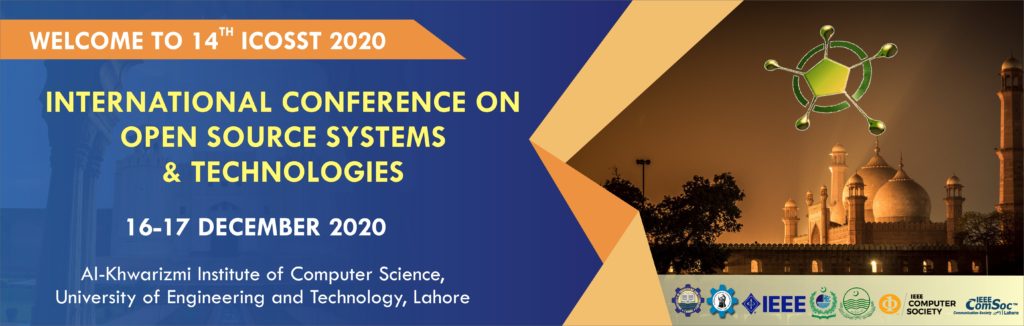
Welcome to IEEE ICOSST 2020
Open-Source Software (OSS) is an established cross-disciplinary paradigm for distributed enterprise computing and e-Government. It is helping organizations both public and private to keep control on the cost of development and deployment. OSS has not only changed the way software applications are architected, deployed, and consumed but also they are engineered to provide large distributed cross-platforms and frameworks.
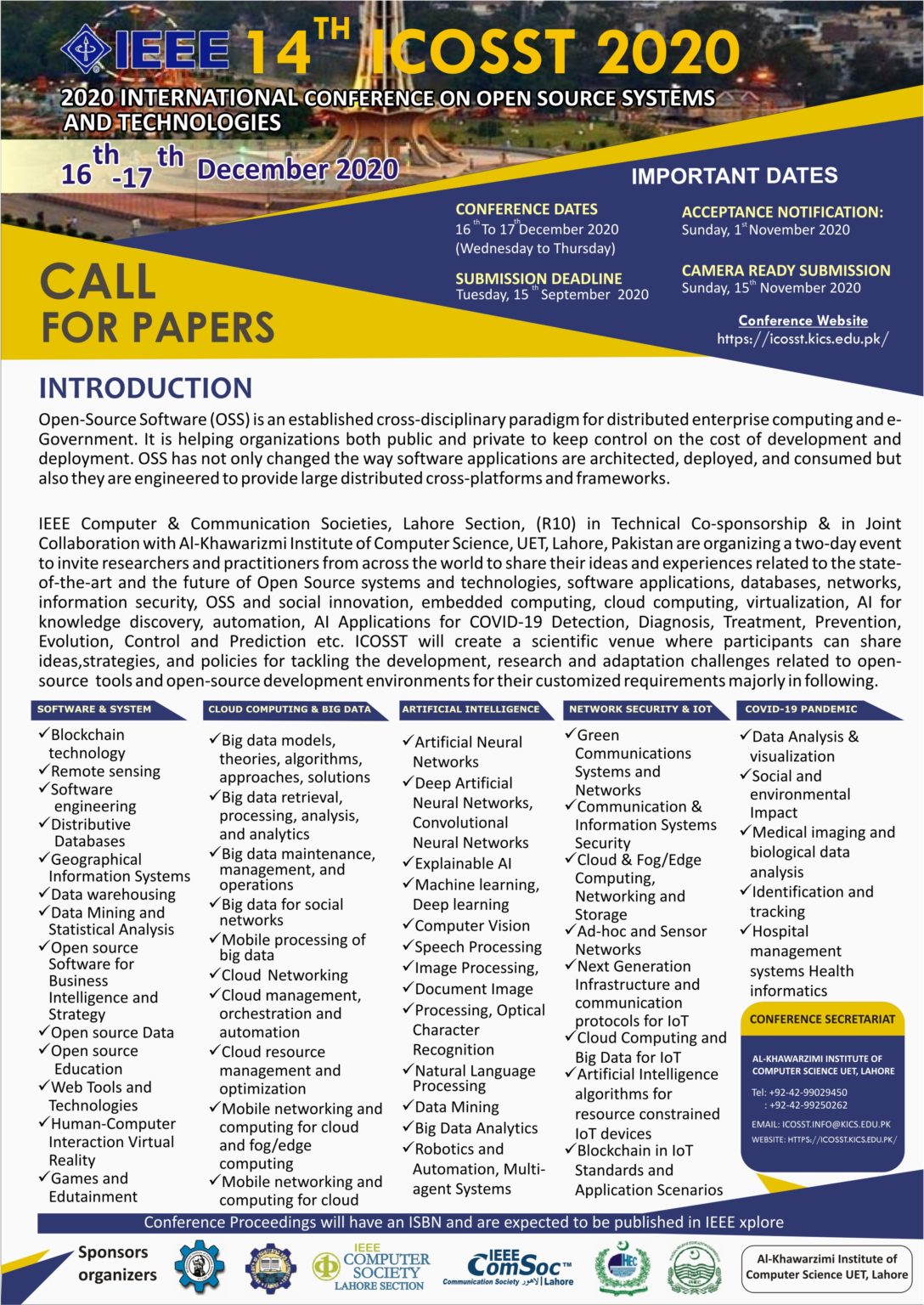
IEEE Computer & Communication Societies, Lahore Section, (R10) in Technical Co-sponsorship & in Joint Collaboration with Al-Khawarizmi Institute of Computer Science, UET, Lahore, Pakistan are organizing a two-day event to invite researchers and practitioners from across the world to share their ideas and experiences related to the state-of-the-art and the future of Open Source systems and technologies, software applications, databases, networks, information security, OSS and social innovation, embedded computing, cloud computing, virtualization, AI for knowledge discovery, automation, AI Applications for COVID-19 Detection, Diagnosis, Treatment, Prevention, Evolution, Control and Prediction etc. ICOSST will create a scientific venue where participants can share ideas, strategies, and policies for tackling the development, research and adaptation challenges related to open-source tools and open-source development environments for their customized requirements. For more detail about the areas click here!
NEWS AND ANNOUNCEMENTS
The 14th IEEE International conference (ICOSST) will be held in UET Lahore , Pakistan from 16 -17 December 2020.
IMPORTANT DATES
BEST PAPER AWARD
The “Best Paper Award” will be given to the authors whose paper(s) will be selected by the technical committee among the papers presented in ICOSST 2020. The paper will be evaluated based on relevance to the symposium’s scope, its scientific contribution, writing and author presentation. The technical committee will send its recommendations to the ICOSST steering committee that will finalize the “Best Paper Award”.
Evaluation Criteria:
Papers are evaluated based on technical merit, originality, potential impact on the field, clarity of the written paper, and quality of the conference presentation.
WEBINAR: ON NODE DEEP LEARNING | By Mr. Ahmad Hassan
On Tuesday, September 15, 2020, NCAI associated Lab AGVRL_KICS_UETL organized a successful webinar by the name of ‘on Node deep Learning’, under the supervision of Dr. Usman Ghani Khan (PI_NCAI). A number of participants including NCAI associated labs i.e. AGVRL, CVML, and private software houses attended the webinar.
The key speaker of the webinar was Muhammad Ahmad Hassan (sr. research officer) AGVRL lab. In this session, he very clearly enlightens the concept of current paradigms of security and surveillance system, problems associated with traditional manual and automatic surveillance systems, current challenges to the CCTV security systems. Further, he also proposed the practical, applicable and reliable solution to all issues related to security and surveillance systems in on node deep learning.
Furthermore, in explanation with the current scenario, he said; our security systems are being shifted to cameras, thermo graphics cameras; video streams based authorization and detection, person authorization, object detection, and site surveillance. But here, the problem is, all this installation needs a force of human resources to monitor and process all the streamed data. That is quite a time-taking and of course, we cannot ignore the chances of human error.
Here, he quoted the example of a safe city. There are almost ten thousand cameras that are continuously generating streams. Let’s if we apply the same concept of “Safe city” to all the provinces, it would be the required installation of almost fifty thousand cameras. These cameras would continuously generate live streams and producing tons of data. If this data is to be filtered, monitored, and processed by a human, it would take approximately ten thousand manpower and months of time. But still, after doing all that, human error and negligence cannot be ignored. As humans cannot pay attention consistently for a long period, he has desires and emotions too. These are unavoidable limitations of traditional security and surveillance systems.
Further limitations of hybrid security surveillance systems are;
- Heavy servers required for video processing.
- Central server dependency.
- On Node decision.
- Network delay.
In case of offline processing the limitations are;
- Difficult to retain such Mammoth data.
- Processing will incur resources.
- Financial constraints.
- Technical constraints.
- Spatial constraints.
Solution for current surveillance challenges
Mr. Muhammad Ahmad Hassan proposed an authentic, reliable solution to all the above-mentioned problems. He also demonstrates the practical application in real time. That was noted and appreciated by all the attendees. According to his proposed solution,
- If each node in the surveillance system work, process and make the decision individually then the system can easily tackle the above-mentioned challenges.
- Processing and decision should be on the individual node and final results can easily be transmitted to the main server.
- Deep learning models can also be implemented if financially affordable. This can easily solve our system problems like; data storage, network delay and on node decision etc.
- On Node deep learning-based automation can also help us to overcome all such problems. For this, we need to embed deep learning models on node.
Further, he also discusses in-depth about on Node processing devices. Some of them are;
Raspberry Pi4
FPGA (Sparten 3e)
NVidia Jetson Nano
Mr. Muhammad Ahmad Hassan also discussed in detail the working model, functionality, and useful features of TensorRT. I.e. it provides high-performance inference in deep learning. It has low latency and high throughput. Its libraries are available in C++ and python. Most importantly, it is compatible with almost all the available framework of deep learning like;
- Tensorflow
- Keras
- MxNet
- Pytorch
- Caffe etc.
The webinar was concluded with a number of live demos and answering the questions raised by the audience. Speaker tried to satisfy them all with comprehensive answers and examples. All attendee was thankful of the institute for arranging such an advance and knowledge-rich webinar.